Let’s give the people what they want: redistricting. JK…the Supreme Court said no. But I’ll at least give you a blog post about it.
Good afternoon and may it please the Court: over half of Virginia’s voters are unhappy. The majority decision—written by the conservative members of the Court—overturns Virginia’s recent redistricting referendum. The opinion emphasizes that it was not meant to overturn the will of the people. Instead, it is about procedure and the meaning of the word “election” in our Constitution.
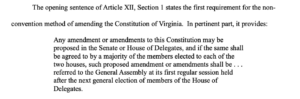
Virginia’s Constitution requires that proposed amendments pass the General Assembly twice, with an intervening general election of the House of Delegates. Virginians began early voting for the general election before the G.A. cast its vote to propose the amendment. So did the general election actually intervene between the two legislative votes?
Readers, please never ask me anything else about Virginia election law. For those who, like my husband, would prefer Claude’s easy-to-understand version:
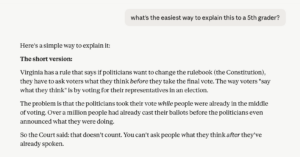
The issue boils down to when an election occurs. Is early voting the start of an election, which takes place over a period of time, as the majority concludes? Or does an election take place only on Election Day (with early voting taking place BEFORE the election starts and ends)? The dissent makes a compelling case in this 4-3 decision.
Please read the decision. Your friends and relatives will all ask you about it anyways. Now at least you can try and avoid having to talk politics with your family on Mother’s Day by distracting them with some fascinating tidbits on Virginia’s election history. Did you know sheriffs used to visit landowners to gather votes? Talk about public service! I would like to personally request a visit by some of my favorite deputies. We get to do it if the founders did. Isn’t that how originalism works?
A few things to note for the legal writing nerds. Justice Kelsey includes MANY footnotes. Is it distracting? Yes. Does it add value? Also yes. The majority’s citations to law review articles, etc. is a tool to bolster their credibility and many of the cited texts provide the historic backdrop to the main arguments. I like the footnotes, personally. I also love the hypothetical about the average voter—you can disagree with his politics but Justice Kelsey is effective! Want to improve your writing? Read other people’s good writing.
There are many thoughts and feelings about this opinion. But I want to mention something the media hasn’t focused on (for unknown reasons): cross-error.
Justice Powell puts in a footnote that the Appellees failed to assign cross-error to one portion of the Circuit Court’s ruling. Fellow appellate nerds know that assigning cross-error is not generally required for alternative grounds for affirmance in the record. But there is an important exception: if the prevailing party is asking to expand their own rights or lessen their adversary’s rights. This cross-error principle isn’t new, but it often isn’t understood. I love procedural defaults and this is advanced appellate practice. A lot of folks don’t think about this so take note of this reminder.
Take-aways
In summary:
- The Supreme Court says its decision isn’t about the politics. But…ya know.
- Procedure matters—in election law and in appeals. Be careful out there.